The "Wreck Photo"

Since 1998, TIGHAR has been speculating whether there is any chance that the wreck shown in this photo might be Earhart's Electra:
Lockheed Electra 10-A
Auckland, NZ
When I was in Auckland, I took photos of an Electra 10-A. These photos support the argument that the cowling of the Electra doesn't come off the way the cowling did of the aircraft in the wreck photo.

The Electra cowling is made in three parts. You can see the parting lines in the picture below at 12, 4, and 8 o'clock.

This is a closeup of the 4 o'clock junction.

This is a closeup of the 8 o'clock junction.

When the Electra cowl is taken off, the engine looks like this:

To my eye, the engine in the wreck photo looks much more like the engine used on the Japanese KI-54:

I am not saying that the wreck can be positively identified as a KI-54; I'm just pointing out that the engine in the photo bears a stronger resemblance to known Japanese engines than to the engines known to have been used on Amelia's Electra. To make the Electra look like the plane in the wreck photo, someone would have to slice the cowls to pieces, leaving only the forward portion intact. That's a heck of a lot of work.
"ATAIU" on the Jeep may stand for "Allied Technical Air Intelligence Unit." The website where I found this picture does not explain its provenance. The two officers (?) on the right certainly look like Allies rather than Japanese, to my untrained eye.
Hmm. This gives rise to a new theory for the wreck photo: it may be a picture of a Japanese warplane that is being scavenged by ATAIU.
Niki Zanzonico argues forcefully and persuasively that the Wreck Photo is a KI-54.
Mark Guimond
"It is completely bogus of course, and it takes absolutely no fund-wasting forensic photo analysis to clearly and definitively come to that conclusion. Why? Simple! No aircraft that I know of that was powered by a single-row P&W engine (i.e. R-985 or R-1340) was ever equipped with a ring-cowl. I have worked on, flown in, photographed, or just 'been around' Beavers, Otters, Norsemans, Twin-Beeches (D-18/AT-11/C-45), Electras, Mallards, Gooses, and maybe a couple more. All have the same type of three-section cowlings as you can clearly see on the ground in front of NR-16020 following the takeoff ground-loop that ended the first flight attempt. You can see for yourselves if you Google up photos of the aircraft just mentioned. The separate ring-cowl was used on many British, European and Japanese aircraft of the period because it served double-duty as the exhaust collector ring, since the exhaust ports on the engines faced forward for better cooling. These rings were made of steel and were mounted directly to the engine, not to the airframe. P&W had the cooling problem under control and the exhaust ports faced aft."
ATAIU
"Captain Frank T. McCoy and Technical Sergeant Francis Williams
helped organize a Materiel Section for technical intelligence operations
in Melbourne, Australia, in 1942. In addition to providing information
on aircraft and weapons performance, Captain McCoy and Sergeant Williams
assigned code names to Japanese aircraft--feminine names for bombers
and masculine names for fighters. It may not be surprising that "Frank"
and "Frances" became the names of two Japanese aircraft. In October
1944, Lieutenant Colonel Frank Mccoy became officer-in-charge of the
newly formed Technical Air Intelligence Unit attached to the Far East
Air Forces."
<http://www.wpafb.af.mil/naic/history%20pt%202.htm>
"TAIU IN CONTROL In October 1944, a Technical Air Intelligence
Unit (TAIU) was formed and attached to the Far East Air Forces. Frank
McCoy, by then a Lt Colonel, was designated Officer-in-Charge. Under
his direction, TAIU took possession and control of all captured Japanese
aircraft and equipment in the Pacific Theater. Earlier in the same
year, a Technical Air Intelligence Center (TAIC) was officially established
in Washington, D.C. (Anacostia), as a joint Army-Navy organization
with British participation. To this center was assigned the responsibility
of collection, evaluation, and dissemination of all technical intelligence
on the Japanese Air Forces. This center worked closely with TAIU in
the field and absorbed part of its experienced personnel. TAIC, during
1945 and 1946, also worked closely and harmoniously with intelligence
at Wright Field. When it was deactivated in the summer of 1946, some
of its key personnel were assigned to technical intelligence at Wright
Field, along with those functions which pertained to the Air Corps."
<http://home.earthlink.net/~husemann/50Years.htm>
"Thereafter, the first TAIU was set up as a joint
USAAF/USN/RAAF organization in Australia in early 1943. This particular
unit absorbed a small team from the Directorate of Intelligence, HQ
Allied Forces, who were developing the Code Name system for Japanese
aircraft they had started in 1942. A second, known as the Allied TAIU
for South East Asia (ATAIU-SEA), followed in Calcutta in late 1943 as
a joint RAF/USAAF Allied unit. Then, in mid 1944, the USN personnel
from the TAIU in Australia were withdrawn to NAS Anacosta, near Washington
DC, to become the TAIC (Technical Air Intelligence Centre), whose purpose
was to centralise and co-ordinate work of test centres in the United
States with work of TAIUs in the field. The operation in Australia was
reformed to function thereafter as TAIU for the South West Pacific Area
(TAIU-SWPA) and eventually moved to the Philippines in early 1945. Two
other operations were also set up, TAIU for the Pacific Ocean Area (TAIU-POA)
as a USN unit to trawl the various Pacific Islands for aircraft and
TAIU for China (TAIU-CHINA) under control of Chiang Kai Shek's Nationalists."
<http://www.j-aircraft.com/research/jas_jottings/end_of_the_jaaf_and_jnaf.htm>
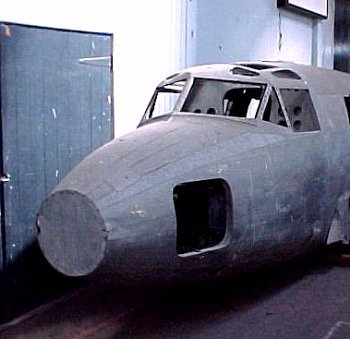
KI-54 Fuselage
Photos from Alfred Hendrickson, though not taken by him. They show a KI-54 fuselage in a museum.
Ric Gillespie, Founder and Director of TIGHAR, October 10, 2006:
"After many years of research and head-scratching, I'm convinced that the Wreck Photo shows a Tachikawa KI-54 "Hickory" advanced trainer.
"My belief is based upon the visible structural components and especially upon the presence of a small circular inspection plate on the nose."
Grumman Goose?

Photo sent me by Deniz Karacay. More on the JRF Goose at
http://www.uscg.mil/hq/g-cp/history/AC_Grumman_JRF.html
Another Goose site: http://www.geocities.com/alaskangoose/
Some people see a line from the nose down that looks a bit like a seaplane. If the cockpit is in the original location, that does suggest some kind of high-wing plane. I've been assuming that the nose of the plane was somehow chopped off the wing in the Wreck Photo.
Grumman Widgeon?
This page says that the Widgeon originally had Pratt & Whitney R-985 engines on it. I can't find any pictures or drawings of a Widgeon with radial engines.
From Herman De Wulf (#2406)
For Dave Bush and others
If anything the picture does not show a PBY. The only twin engine seaplanes I can think of that look a bit like the airplane in the wreck photo are Grummans. There are two that come to mind that might fit. Grumman's Model G-21 of 1937 this was an eight seat commercial amphibian. When used by the US Navy it became the JRF-1. Later versions were JRF-2, -3, -4, -5 and -6. In all 275 were built for the US Navy and Coast Guard. They were used as light transports, target tugs, navigation trainers, photographic reconnaissance and for air-sea rescue missions. The USAAF also received 31 and called them OA-9. Later five OA-13 joined them. I think it is very unlikely one would find the type on coral islands in the Pacific, too far away from the US. However, JR-5s and -6s were supplied to the RCAF and especially to the RAF who both called the type Goose. But when looking at the wreck picture again one can exclude the JRF or the Goose because the nose doesn't fit the picture in the wreck photo... That leaves us with the Grumman J4F Widgeon. Derived from Grumman's civilian G-44 in 1940, this four/five seat amphibian was used by the US Coast Guard as the J4F-1. The Navy used the J4F-2 from 1942 on and small numbers were supplied to the USAAF as the OA-14. This type too was supplied to Canada and Britain. The Royal Navy called them Gosling. The interesting thing about the Gosling is that the British used them in the Far East. That's where one would find palm trees and volcanic mountains in the background as in the wreck picture. However I have TWO problems with the Widgeon/Gosling. First the picture I have of a US Widgeon shows the aircraft with a pair of 200 hp Ranger L-440C-5 inline engines. That doesn't prove anything for in 1997 I saw two privately-owned beautifully restored Widgeons at the Flying Legends Air Show at Duxford (Britain), both having shiny radial engines, not unlike the Wasps used in the Lockheed 12. However, the engines had three bladed propellers. Again that doesn't prove anything for this summer there was a French-owned Lockheed 12 Electra Junior at Duxford, which was also equipped with untypical three-bladed propellers. Even the legendary German Junkers Ju-52/3m had been re-equipped with three bladed propellers! The reason why, I was told, is that besides giving greater speed, three bladed props are compulsory on Wasps or comparable engines to comply with today's European noise regulations... At certain airports AT-6s are not allowed to take off under full power to reduce noise at take off! I wonder if there is anyone on the forum who is familiar with the WW II Grumman amphibious types and can explain this change of engine from the inline Franklin to what I believe to be a Pratt & Whitney Wasp. BUT... the main problem I have with the Grummans of either type is that they had a typical cockpit windshield layout which is not shown in the wreck photo. Therefore I hesitate to conclude the airplane in the picture is a Widgeon or, more likely, a Gosling in a palm tree setting with volcanic mountain setting. Ric at one time believed the wreck photo showed a Lockheed 10. Then he changed his mind and now believes it is a Tachikawa Ki-54 Hickory. Could be. But I'm still not 100 % convinced it is not one of the 32 Dutch Lockheed 12s (Lockheed 212 and Lockheed 12-26) the Netherlands air force lost in the Dutch East Indies during the Japanese invasion. This might also explain the palm trees and the volcanic mountain landscape.
LTM (who loves seaplanes)
Ki-49 Helen?
Martin Ferkl's theory.
http://www.j-aircraft.com/artwork/ki49_helen_by_win_jackson.htm